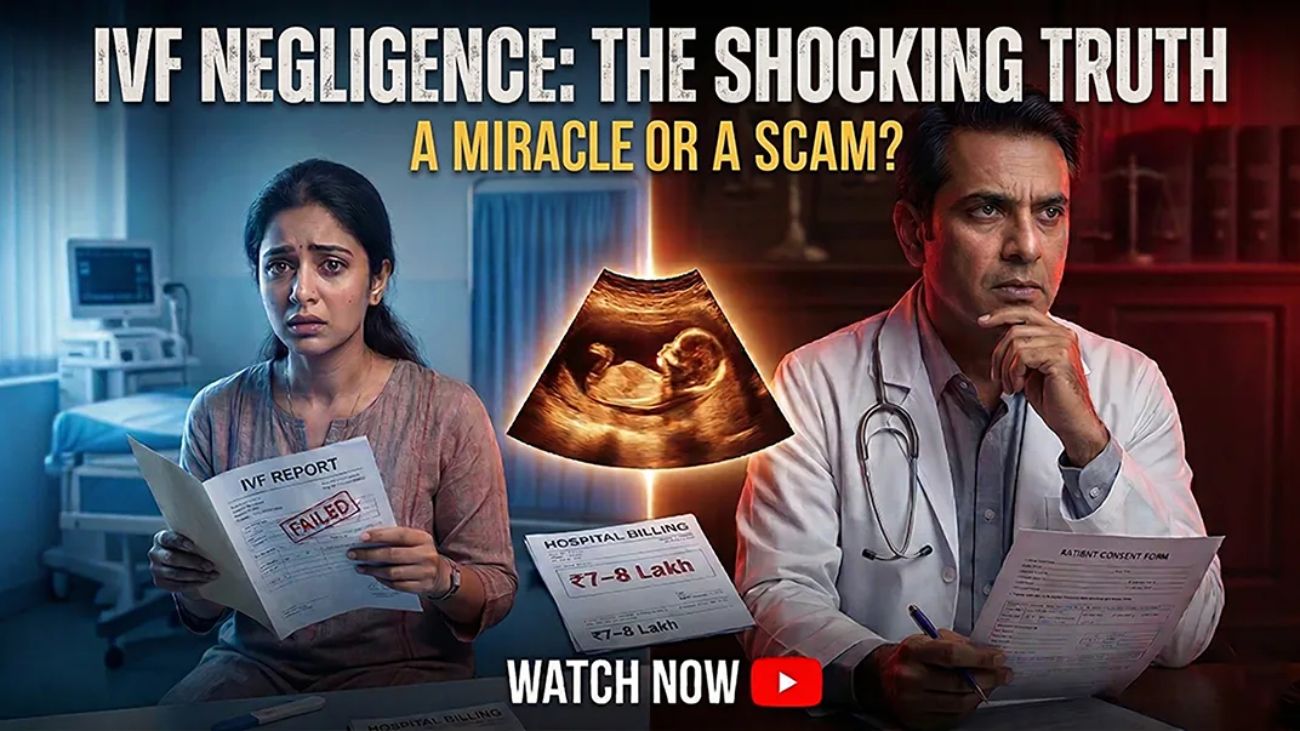
In IVF-related disputes, one important legal misunderstanding appears again and again: many people assume that if an IVF cycle fails, medical negligence is automatically established. That is not correct. A failed IVF cycle, by itself, does not prove negligence. IVF is a treatment with known limitations, variable success rates, and no guaranteed outcome. However, the medico-legal picture can become far more complex when an unexpected twist appears later—especially if the same patient conceives naturally after the failed IVF attempt.
Imagine a couple spends ₹7–8 lakh on IVF. The treatment fails, pregnancy does not occur, and they feel emotionally and financially devastated. A legal complaint is then filed against the doctor or fertility clinic. At first glance, the doctor may appear to have a strong defence: IVF never carries a 100% success guarantee, and treatment failure alone is not negligence. In many cases, that defence is legally and medically valid.
But now consider the twist. Two and a half years later, the same patient becomes naturally pregnant.
At that point, the dispute can shift in a completely different direction. The doctor may argue that the later pregnancy somehow reflects a delayed benefit of earlier fertility treatment. The patient, on the other hand, may raise a troubling question: if natural pregnancy was still possible, why was IVF advised in the first place? Was IVF truly indicated, or was the patient subjected to an unnecessary, costly, and emotionally difficult procedure?
This is where medico-legal analysis becomes essential.
In such cases, the outcome usually depends less on the failure of IVF itself and more on three critical pillars: indication, counselling, and consent.
First, indication. Was IVF medically justified at the time it was advised? Was there a proper fertility workup, a reasonable diagnosis, and a sound clinical basis for recommending IVF instead of trying other options first?
Second, counselling. Was the patient properly informed about the realistic chances of success, the financial and emotional burden, the limitations of IVF, and the possibility—however limited—of natural conception?
Third, consent. Was all of this clearly documented in a written informed consent process? Good documentation often becomes the strongest defence in medico-legal disputes.
A very important scientific and legal caution must also be remembered: a later natural pregnancy does not automatically prove that the earlier failed IVF caused that pregnancy. In other words, association is not the same as causation. A spontaneous pregnancy occurring years later may happen for several reasons, and it should not casually be presented as a proven delayed direct benefit of a failed IVF cycle unless case-specific evidence supports that conclusion.
Therefore, the real medico-legal issue is not simply whether IVF failed. The real issue is whether the treatment was appropriately advised, whether alternatives were discussed honestly, and whether the patient made an informed choice based on clear counselling.
If proper indication, proper counselling, and proper written consent are present, a failed IVF cycle may not amount to negligence. But if these are weak, absent, or poorly documented, the legal concern may shift toward unnecessary treatment.
At Doctor in Law, we believe that in fertility-related disputes, the strongest cases often turn not on outcome alone, but on communication, documentation, and standard of care.
Last Tuesday evening, my phone lit up with a call from Dr. Vikram Solanki—my old batchmate from medical college. Vikram is the kind of surgeon who lives in the OT, sleeps four hours a night, and breathes medicine. But that evening, his voice was shaking.
“Shashank,” he started, breathless. “It happened. A patient has filed a medical negligence case against me.”
Before I could say anything, his tone suddenly shifted from panic to relief.
“But wait—I just checked. You’re on my insurance panel as a consultant! Thank God. You handle everything from here. I’m just going to relax now that I know you’re on it.”
I had to stop him right there.
“Vikram, relax mat kar. You will have to stay involved. I will guide you, but you cannot leave everything on the lawyer or the insurance company. This is the biggest mistake you can make.”
There was silence on the other end.
This is exactly where most doctors go wrong. They assume that once a legal notice arrives, they hand it over to a lawyer—any lawyer on the panel—and wash their hands of the matter. They trust the process blindly… usually until it’s too late.
And this blog is to make sure you don’t.
Why a Doctor Must Stay Involved—Not Blindly Trust Any Lawyer
Medical negligence cases are not like property disputes or contract cases. Here, your reputation, your career, your medical licence, and sometimes even your freedom is at stake.
A lawyer may be brilliant, but he does not know medicine.
If you don’t stay involved, here’s what happens:
Important medical facts get lost in translation
Case timelines become confusing
The opposite party’s narrative becomes stronger
Your lawyer may negotiate or argue without medical clarity
You may end up paying unnecessary compensation—or worse, face disciplinary action by the National Medical Commission (NMC)
Your involvement ensures:
Correct sequence of events
Accurate medical terminologies
Proper interpretation of consent forms, notes, vitals, records
Strong rebuttal based on clinical facts
A solid standard-of-care argument
A lawyer protects you legally. But only a doctor can protect the medical truth.
Both must work together. This is not just a legal case—it is an examination of your professional life.
Why Choosing the Right Lawyer is Critical
When you choose a lawyer for a medical negligence case, you aren’t just hiring someone to file paperwork. You are entrusting them with protecting you from:
Potential jail time
Massive financial compensation claims that could bankrupt you even with insurance
Suspension or cancellation of your medical license
Your lawyer is your gladiator in an arena you don’t understand. Their skill directly influences:
The outcome of the case (Will you be found guilty or innocent?)
The duration (Will it take 2 years or 10 years?)
The number of hearings (Will you be dragged to court 50 times or 10 times?)
Case gets delayed, poor drafting, emotional arguments, no clear direction
An expert medico-legal lawyer also provides critical support that novices miss:
a. Settlement Options (BATNA/BATKA) They know how to calculate your “Best Alternative to a Negotiated Agreement.” If the clinical evidence is weak, they will know the exact moment and amount to settle for, saving your reputation.
b. Speeding Up the Process A good lawyer pushes for early disposal, avoids unnecessary adjournments, discusses full disclosure strategies, and gives you realistic timelines.
c. Non-Emotional Bargaining As doctors, we get emotional when accused of negligence. We take it personally. A good lawyer acts as a firewall, conducting unemotional, calculated negotiations with the opposing side—no communication gaps, no drama.
d. Pre-Litigation Meetings Often, a matter can be resolved by bringing the aggrieved patient’s family to the table before a formal case is filed. This requires immense tact and diplomatic legal skills.
This is the power of choosing wisely.
What to Do BEFORE Visiting a Lawyer
You wouldn’t operate on a patient without imaging and tests. Similarly, don’t walk into a lawyer’s office empty-handed.
A) Make a Case Summary and Timeline
Write a simple, chronological summary:
What happened
When it happened (dates, times)
What symptoms the patient had
What treatment you gave
What records you created (vitals, notes, consent forms)
What discussions happened with attendants
This helps the lawyer immediately understand your standard of care, identify gaps, spot strong points, recognize weak points, and follow the medical logic.
B) Exercise Your Rights as a Client
Just as we emphasize “informed consent” for our patients, you must exercise your right to “informed representation.”
You have the right to:
Get a full explanation of the legal strategy
Ask questions
Know the case strategy and timeline
Get copies of case documents
Understand the payment structure
Receive regular updates
A good lawyer never hides or avoids these.
Checklist of a Good Lawyer for a Medical Negligence Case
Here is your Doctor’s 360° Checklist—use this before finalizing your lawyer.
1. How Quickly He Understands Your Summary and Timeline
When you present your case summary, how fast do they grasp the medical and legal nuances? If you spend three hours explaining basic anatomy, they aren’t the right fit. A strong medico-legal lawyer grasps the clinical picture rapidly.
2. The Instant SWOT Analysis: 2-3 Strong Points AND 2-3 Weak Points
If your lawyer only sees “everything is strong”—be cautious. A real expert identifies both sides. Within the first meeting, they should point out major strengths in your defense and, more importantly, critical weaknesses the opposition will exploit.
3. Bargaining Strategy
Does he discuss settlement, negotiation tactics, BATNA/BATKA, and realistic expectations? If yes, he is experienced and strategic.
4. Who is Actually Fighting the Case?
Some lawyers act as “agents.” They take your case but send it to a senior counsel with whom you never get to talk. This causes miscommunication and poor defense.
Ask directly: “Will you personally handle my case, or will someone else argue it?”
Choose someone who either personally handles it or ensures you have direct communication with the senior lawyer.
5. Substance Over Rhetoric
Beware the lawyer who says:
“Aap nishchint raho”
“Band baja denge”
“Opposite ka case udd jaayega”
…without talking specifics. That’s a red flag.
A real expert talks professionally:
“These are your strong points”
“These are the weak links”
“This is our strategy for hearings”
“These documents are missing”
6. Gives 2-3 Strategy Options
He should offer multiple approaches:
Defensive + aggressive litigation
Settlement-focused approach
Legal + medico-legal hybrid strategy
Options mean experience.
7. Document Awareness
A proactive lawyer will ask for missing documents—prescriptions, nursing notes, consent forms, discharge summaries. If they ask, “Doctor, where are the nursing notes from the night of the 14th?” it means they are deeply involved. Silence on missing documents is a red flag.
8. Keeps You Updated
Very important:
Does he save your number?
Does he communicate on WhatsApp?
Does he give you a personal mobile number, not just a landline?
Does he update you after every hearing?
If you can only reach their landline via a secretary, you will feel isolated during the process. A lawyer who keeps you informed is reliable.
9. Digital Presence
Website, blogs, case studies, social media presence. This shows:
Confidence
Transparency
Hunger for professional branding
Long-term commitment
A lawyer hungry for their own professional branding will fight harder for yours. He fights your case and also fights for his reputation—a powerful combination.
10. Knows Doctors or Has Dealt With Medical Cases Before
Experience matters. If he has:
Handled doctor cases
Knows medical processes
Understands medical records
Worked with hospitals
…then your chances improve significantly.
11. Has a Medico-Legal Expert Panel
This is extremely important and often the game-changer.
Medical negligence hinges on “standard of care”—a technical gray area. The same medical facts can be argued positively or negatively.
A medico-legal expert can help the lawyer:
Build timelines with crystal clarity
Strengthen medical arguments with literature
Prepare strong rebuttals
Reference Supreme Court and NCDRC judgments
Highlight gaps in the opposite party’s claim
This acquired skillset comes with experience and is the difference between case winning and early case winning.
12. Shows Old Case References (Available on Court Websites)
Check their track record. Many court websites allow you to search past cases. This proves credibility and experience.
13. Transparent Payment System
No hidden charges. Clear structure. Written estimate. Professional receipts.
Transparency equals trust.
Final Thoughts
When Dr. Vikram asked me to “handle everything,” he meant it out of trust. But I told him what I’m telling you now: trust should not replace involvement.
A medical negligence case is a joint mission between doctor, lawyer, and medico-legal expert.
Choosing the right lawyer can protect your career, your peace of mind, and your future in medicine. Your degree is hard-earned. Don’t hand its fate over blindly.
So be smart. Be informed. Be involved.
Remember:
“Doctor knows Medicine, Lawyer knows Law—But your future depends on how well both work together.”
Your career is literally in their hands. Choose wisely.
Medical negligence occurs when a healthcare professional deviates from the accepted standard of care, resulting in harm to the patient. This breach of duty is considered negligence when the practitioner fails to act as a reasonably competent professional would under similar circumstances. For instance, if a surgeon leaves a surgical instrument inside a patient’s body after surgery, this would be an example of medical negligence. The surgeon had a duty to ensure all instruments were accounted for, and the failure to do so resulted in harm to the patient. Medical negligence can occur at any stage of patient care, from diagnosis to treatment, and even post-operative care. It’s important to note that not all medical errors are considered negligence—only those that involve a breach of the standard of care that directly causes harm to the patient.
2. Common Examples of Medical Negligence
Medical negligence can manifest in various ways, some of the most common examples include misdiagnosis, surgical errors, and medication mistakes. Misdiagnosis occurs when a doctor incorrectly diagnoses a condition, leading to improper treatment. For example, if a patient with early-stage cancer is misdiagnosed with a benign condition, the delay in appropriate treatment can allow the cancer to progress, causing severe harm or even death. Surgical errors, such as operating on the wrong body part, are glaring examples of negligence. Another common instance is medication errors, where a patient is prescribed the wrong medication or dosage, leading to adverse effects. For instance, if a patient is allergic to penicillin and a doctor prescribes it without checking the patient’s history, resulting in a severe allergic reaction, this would constitute medical negligence.
3. Duty of Care in Medical Negligence
The concept of “duty of care” is central to medical negligence. It refers to the legal obligation of healthcare professionals to adhere to a standard of reasonable care while performing any acts that could foreseeably harm patients. This duty requires medical practitioners to act in a manner that is consistent with the standards of their profession. For example, a doctor has a duty of care to diagnose and treat patients with the competence expected of a similarly trained professional. If a general practitioner fails to refer a patient with symptoms of a heart attack to a cardiologist, and the patient suffers harm as a result, this could be considered a breach of the duty of care. In essence, the duty of care is the foundation of trust between patients and healthcare providers.
4. Dereliction of Duty in Medical Negligence
Dereliction of duty, also known as breach of duty, occurs when a healthcare professional fails to meet the standard of care required in a particular situation. This failure can take many forms, such as omitting necessary treatment, providing incorrect treatment, or failing to obtain informed consent. For instance, if a doctor fails to diagnose a life-threatening condition like a stroke, despite the presence of clear symptoms, this could be seen as dereliction of duty. The breach must be significant enough that it deviates from what a reasonably competent professional would do in similar circumstances. Dereliction of duty is a critical component in establishing medical negligence, as it directly links the healthcare provider’s actions (or lack thereof) to the harm suffered by the patient.
5. Consequential Damage in Medical Negligence
Consequential damage refers to the harm that results directly from a healthcare provider’s negligent actions or omissions. For a medical negligence claim to be valid, the plaintiff must prove that the breach of duty caused actual harm or injury. This harm can be physical, emotional, or financial. For example, if a surgeon negligently perforates a patient’s bowel during surgery, resulting in severe infection and prolonged hospitalization, the additional medical expenses and suffering experienced by the patient would be considered consequential damage. Without demonstrable damage, a medical negligence claim cannot succeed, even if there was a clear breach of duty. Consequential damage is a vital element in proving that negligence directly led to the patient’s harm.
6. Lack of Skill in Medical Negligence
Lack of skill refers to situations where a healthcare provider does not possess the necessary expertise or fails to apply their skills appropriately, leading to patient harm. This can occur when a practitioner attempts to perform a procedure or provide treatment that is beyond their competence level. For instance, if a general practitioner attempts a complex surgical procedure that should be performed by a specialist, and the patient suffers complications as a result, this could be considered negligence due to lack of skill. The law expects healthcare providers to know their limitations and seek assistance or refer patients to more qualified professionals when necessary. Failing to do so, and causing harm as a result, can be grounds for a medical negligence claim.
7. Standard of Care in Medical Negligence
The “standard of care” in medical negligence refers to the level of care and competence that a reasonably skilled healthcare professional, with similar training and experience, would provide under similar circumstances. It serves as the benchmark against which a healthcare provider’s actions are measured. For instance, if a patient presents with symptoms typical of appendicitis, the standard of care would require the physician to perform the necessary diagnostic tests to confirm or rule out the condition. If the doctor dismisses the symptoms without investigation, leading to a ruptured appendix, this could be a breach of the standard of care. The standard of care is not uniform but varies depending on the medical field, the patient’s condition, and the available resources.
8. Hypothetical Scenarios Indicating Medical Negligence
Scenario 1: A woman undergoes a routine hysterectomy. During the surgery, the surgeon inadvertently damages her bladder. The damage is not recognized or repaired during the operation. Post-surgery, the patient experiences severe pain and recurrent infections, eventually requiring additional surgeries to repair the damage. This scenario illustrates surgical negligence due to a breach of the standard of care.
Scenario 2: A child is brought to the emergency room with high fever, rash, and stiff neck—classic signs of meningitis. The attending physician diagnoses it as a viral infection without conducting a lumbar puncture, which is the standard diagnostic test for meningitis. The child’s condition worsens, leading to severe brain damage. This scenario exemplifies misdiagnosis and failure to adhere to the standard of care.
Scenario 3: An elderly patient is prescribed a new medication by her doctor, who fails to review her current medications for potential interactions. The patient subsequently suffers a severe adverse reaction, leading to hospitalization. This scenario indicates negligence due to a lack of diligence in checking for drug interactions, which is part of the standard of care in prescribing medications.
These scenarios demonstrate how medical negligence can occur in various contexts, leading to serious consequences for patients.