
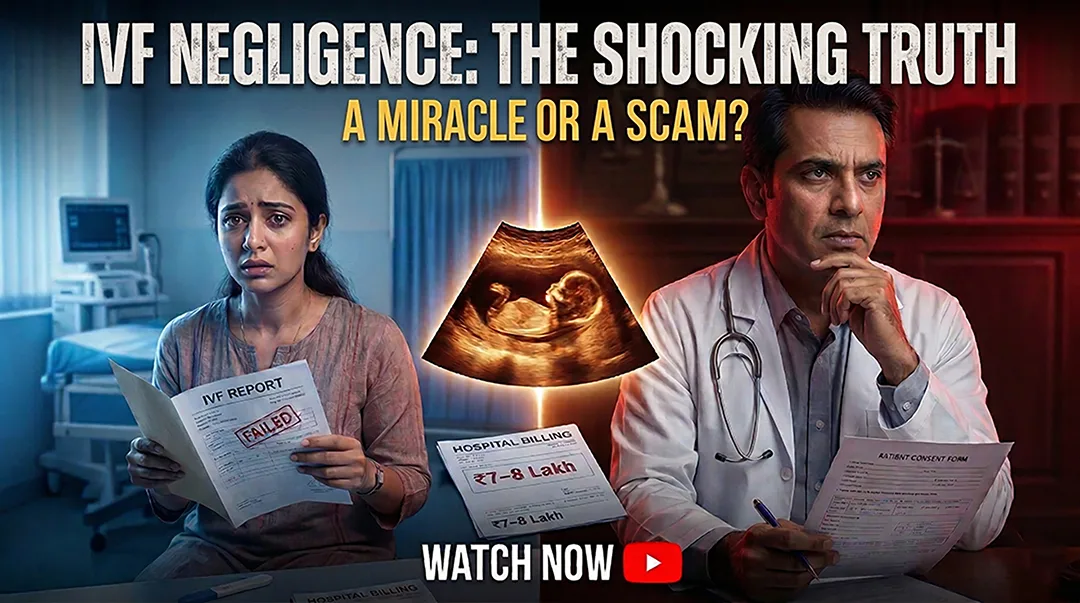
In IVF-related disputes, one important legal misunderstanding appears again and again: many people assume that if an IVF cycle fails, medical negligence is automatically established. That is not correct. A failed IVF cycle, by itself, does not prove negligence. IVF is a treatment with known limitations, variable success rates, and no guaranteed outcome. However, the medico-legal picture can become far more complex when an unexpected twist appears later—especially if the same patient conceives naturally after the failed IVF attempt.
Imagine a couple spends ₹7–8 lakh on IVF. The treatment fails, pregnancy does not occur, and they feel emotionally and financially devastated. A legal complaint is then filed against the doctor or fertility clinic. At first glance, the doctor may appear to have a strong defence: IVF never carries a 100% success guarantee, and treatment failure alone is not negligence. In many cases, that defence is legally and medically valid.
But now consider the twist. Two and a half years later, the same patient becomes naturally pregnant.
At that point, the dispute can shift in a completely different direction. The doctor may argue that the later pregnancy somehow reflects a delayed benefit of earlier fertility treatment. The patient, on the other hand, may raise a troubling question: if natural pregnancy was still possible, why was IVF advised in the first place? Was IVF truly indicated, or was the patient subjected to an unnecessary, costly, and emotionally difficult procedure?
This is where medico-legal analysis becomes essential.
In such cases, the outcome usually depends less on the failure of IVF itself and more on three critical pillars: indication, counselling, and consent.
First, indication. Was IVF medically justified at the time it was advised? Was there a proper fertility workup, a reasonable diagnosis, and a sound clinical basis for recommending IVF instead of trying other options first?
Second, counselling. Was the patient properly informed about the realistic chances of success, the financial and emotional burden, the limitations of IVF, and the possibility—however limited—of natural conception?
Third, consent. Was all of this clearly documented in a written informed consent process? Good documentation often becomes the strongest defence in medico-legal disputes.
A very important scientific and legal caution must also be remembered: a later natural pregnancy does not automatically prove that the earlier failed IVF caused that pregnancy. In other words, association is not the same as causation. A spontaneous pregnancy occurring years later may happen for several reasons, and it should not casually be presented as a proven delayed direct benefit of a failed IVF cycle unless case-specific evidence supports that conclusion.
Therefore, the real medico-legal issue is not simply whether IVF failed. The real issue is whether the treatment was appropriately advised, whether alternatives were discussed honestly, and whether the patient made an informed choice based on clear counselling.
If proper indication, proper counselling, and proper written consent are present, a failed IVF cycle may not amount to negligence. But if these are weak, absent, or poorly documented, the legal concern may shift toward unnecessary treatment.
At Doctor in Law, we believe that in fertility-related disputes, the strongest cases often turn not on outcome alone, but on communication, documentation, and standard of care.